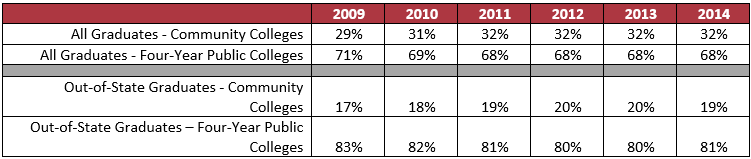
Table 1. Out-of-state Graduates from Maryland Public6Colleges

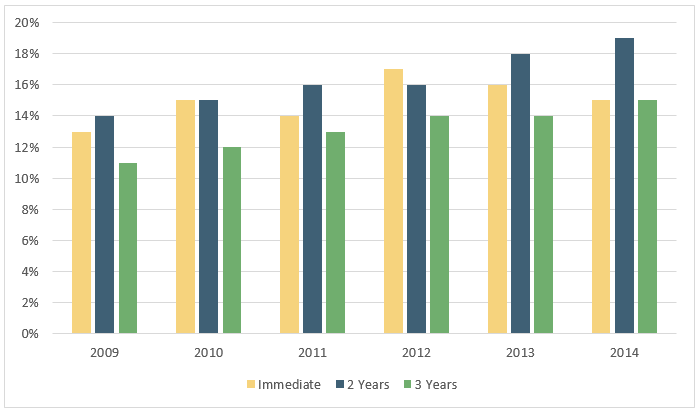
Of those out-of-state graduates, on average, 15% of each graduating cohort are engaged in the Maryland workforce in the first three years immediately following graduation. However, as shown in Chart 1, there are fluctuations in the percentage of out-of-state graduates that are engaged in the Maryland workforce. In several instances (2009, 2011, 2013, and 2014), the percentage of out-of-state graduates engaged in the Maryland workforce increases from the first year after immediately graduating to the second year after graduating. This may be the result of the time it takes a new graduate to find a job and the fact that a graduate is not counted as engaged in the workforce unless he or she worked all four quarters of that year. It is also notable that, for each cohort year, engagement in the Maryland workforce appears to drop off by three percentage points from the second to third year after graduation. Whether this represents out-of-state students returning to their home states for work or simply transitioning to employment that is not reported to Unemployment Insurance will require additional research. Finally, these cohorts are graduating from college during a period still impacted by the Great Recession. For the out-of-state graduates, this may have resulted in them not being able to find major-related employment in Maryland and therefore returning home rather than staying in Maryland to work for lower wages in part-time or non-career track jobs.7
Chart 1. Out-of-State Graduates - Maryland Workforce Engagement
The majority (70%) of graduates under consideration in this report are from four-year public colleges. For out-of-state students, 80% graduated from a Maryland four-year public college (see Table 2 below).
Table 2 - Percentage of Graduates by College Sector
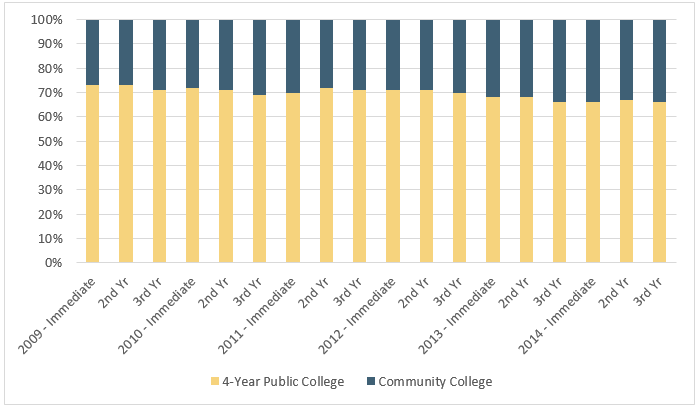
Of the out-of-state graduates who are engaged in the Maryland workforce, approximately two-thirds graduated from a Maryland four-year public college. The vast majority (97%) of four-year public college graduates earned a Bachelor’s degree. This is a positive finding that indicates that highly trained out-of-state graduates remain in Maryland, engaged in the workforce (see Chart 2). It should be noted that there is a trend beginning with the 2013 cohort, which shows a slight decline in the proportion of four-year college graduates and a corresponding increase in the proportion of community college graduates that are engaged in Maryland’s workforce. Whether this trend continues or is tied to the Great Recession will be a subject of future analysis for the Center.
Chart 2. Out-of-State Graduates Engaged in the Maryland Workforce - Sector Comparison