discussion
Why Brain Gain and Brain Drain Matters
The U.S. Congress, Joint Economic Committee produced a 2019 report entitled, Losing Our Minds: Brain Drain across the United States.8 The report argues that, “states that fail to retain the most-skilled of those born within their borders – or that fail to replace them by attracting the most-skilled born in other states – are at risk of economic stagnation.” This suggests that brain drain and brain gain are significant issues that require careful attention and, where indicated, policy interventions. For example, Indiana, which is 16th in the U.S. for the number of college degrees conferred by its institutions, but 40th in the number of residents with a degree, has implemented a multi-pronged approach to improving brain gain. One initiative by Mitch Daniels, former Governor and current President of Purdue University, is to reach out to Purdue alumni in other states with the goal of identifying alumni interested in returning to Indiana for work and then putting them in contact with a network of Indiana employers.9
Future Research
As stated above, a prior MLDS research report has shown that Maryland suffers from brain drain: academically talented Maryland high school students attend out-of-state colleges and are then less likely to return and engage in the Maryland workforce. However, this report shows that the state is also able to attract and retain in the Maryland workforce highly skilled out-of-state students who attend and graduate from Maryland public colleges and universities. Whether the state’s losses can be offset by the number of out-of-state college graduates who are found engaged in the Maryland workforce will require additional research. Specifically, research and reporting on the following topics is needed:
- Adding more years to brain gain and brain drain analyses to help understand: (a) for brain gain, whether the out-of-state graduates remain in Maryland for five or more years; and (b) for brain drain, whether the relocation to another state is permanent or temporary (i.e. do we find that, 5 five years later, Marylan dhigh school graduates who leave Maryland for college ultimately return to Maryland with an education and career skills);
- Conducting an analysis that includes students attending Maryland’s state-aided independent colleges and universities, which notably have a majority (60%) of undergraduate students who are from out-of-state10;
- Developing an analysis that can provide better insight into whether the state’s loss of Maryland students attending college out-of-state and not returning to Maryland is being sufficiently offset by gains made by out-of-state graduates remaining in Maryland and engaged in the workforce; and
- Determining how does brain gain support and brain drain hinder Maryland’s 55% completion goal (55% of its residents who are between the ages of 25 to 64 holding at least one postsecondary degree credential by 2025).
National Perspective
The Joint Economic Committee Report on Losing Our Minds: Brain Drain across the United States, Social Capital Project,11 focuses on migration between states by looking at the state in which an adult is observed in the data12 when they were between the ages of 31 and 40. Further it looks at the extent to which states are losing their best-educated children, determined by a ranking based on educational attainment and earning power. The report looks at different types of brain drain, including “gross brain drain” and “net brain drain.” Gross brain drain occurs when skilled children don’t remain in state as adults. The report lists Maryland as a low gross brain drain state.
… low [gross] brain drain states also include relatively affluent states with dynamic economies (Hawaii, Illinois, Maryland, Massachusetts, New York, and New Jersey). These states often neighbor high-brain-drain states and serve as regional hubs. These affluent states have birth cohorts with medium to high education levels and also generally have somewhat high outmigration rates. (see page 12 of the report)
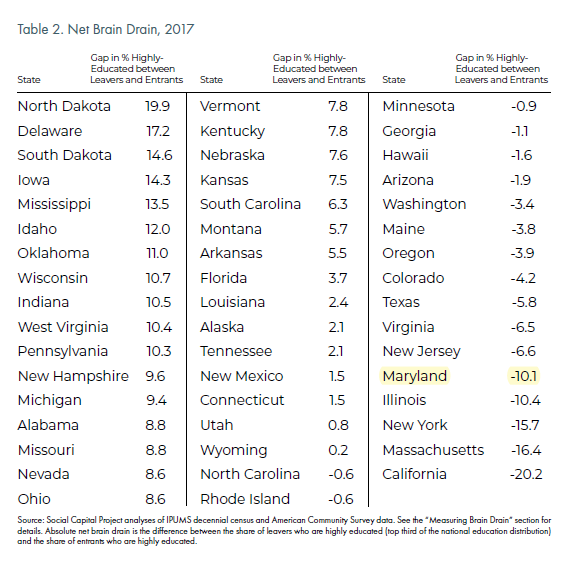
Net brain drain seeks to determine whether the loss of state-born talent exceeds the in-migration of out-of-state talent. If the losses exceed the gains, the state experiences net brain drain. If the gains exceed the losses, then the state experiences net brain gain. The calculation is made by subtracting the percent of “entrants” who are highly educated from the percent of “leavers” who are highly educated. The chart below from the report, shows that Maryland has a negative score which indicates net brain gain or that Maryland imports more highly educated talent that it loses. In fact, Maryland has the fifth highest brain gain score among all states.
Policy Implications
Maryland could consider modifying existing policies or expanding student services to capitalize on the potential for brain gain.
The State of Maryland invests heavily in grant and scholarship programs to attract and retain graduates from Maryland’s public high schools and adults pursing additional postsecondary education. Targeted financial assistance programs, while currently limited to Maryland residents, could be expanded to attract out-of-state students. For example, the 2+2 Transfer Scholarship, Near Completer Grant, Cybersecurity Public Service Scholarship, and Workforce Shortage Student Assistance Grant are all limited to Maryland residents and yet, if residency was not required or if residency could be established within one semester, these programs might help attract out-of-state students to Maryland’s institutions of higher education. The financial programs could be amended to require students to complete a service obligation in Maryland after graduation as compensation for funding. Maryland colleges could also consider reducing the premium charged for tuition for out-of-state students. Reducing the out-of-state tuition to make it competitive with paying in-state tuition at neighboring states, may lead to additional brain-gain in Maryland.
Finally, colleges can expand on student services and strengthening ties to the local labor markets to increase the rate of brain gain. Internships prior to graduation with Maryland business could provide graduates with a direct path into the Maryland labor market. Wages for interns could be subsidized so that Maryland business are incentivized to take on out-of-state students with the intent of converting them to brain gains. Colleges should also focus efforts on placement services for graduates, making sure local businesses as well as large national employers, participate in career and recruitment fairs.